
THE
4 MASTER
SUITES
Four titles, four worlds. With Earth, Dream, Prey, and Sin, I composed spaces where literature turns into atmosphere, and words become walls.
CONCEPT
The guiding idea was to let each suite embody one of Zola’s themes with its own materiality, palette, and rhythm. Walls and interiors were composed like chapters: distinct yet part of a greater story. Collaboration with artists and designers brought further layers, ensuring each room became a complete experience, not just a decorative gesture.


CRAFTING FOUNDATION
Across all four suites, strong bases anchor the work: mineral surfaces, natural pigments, fabrics, metals, and wood. Each element was selected for its ability to age, to carry patina, and to hold memory — so that the foundation itself is already alive with character.
ROOM 208 — THE EARTH
"LA TERRE"
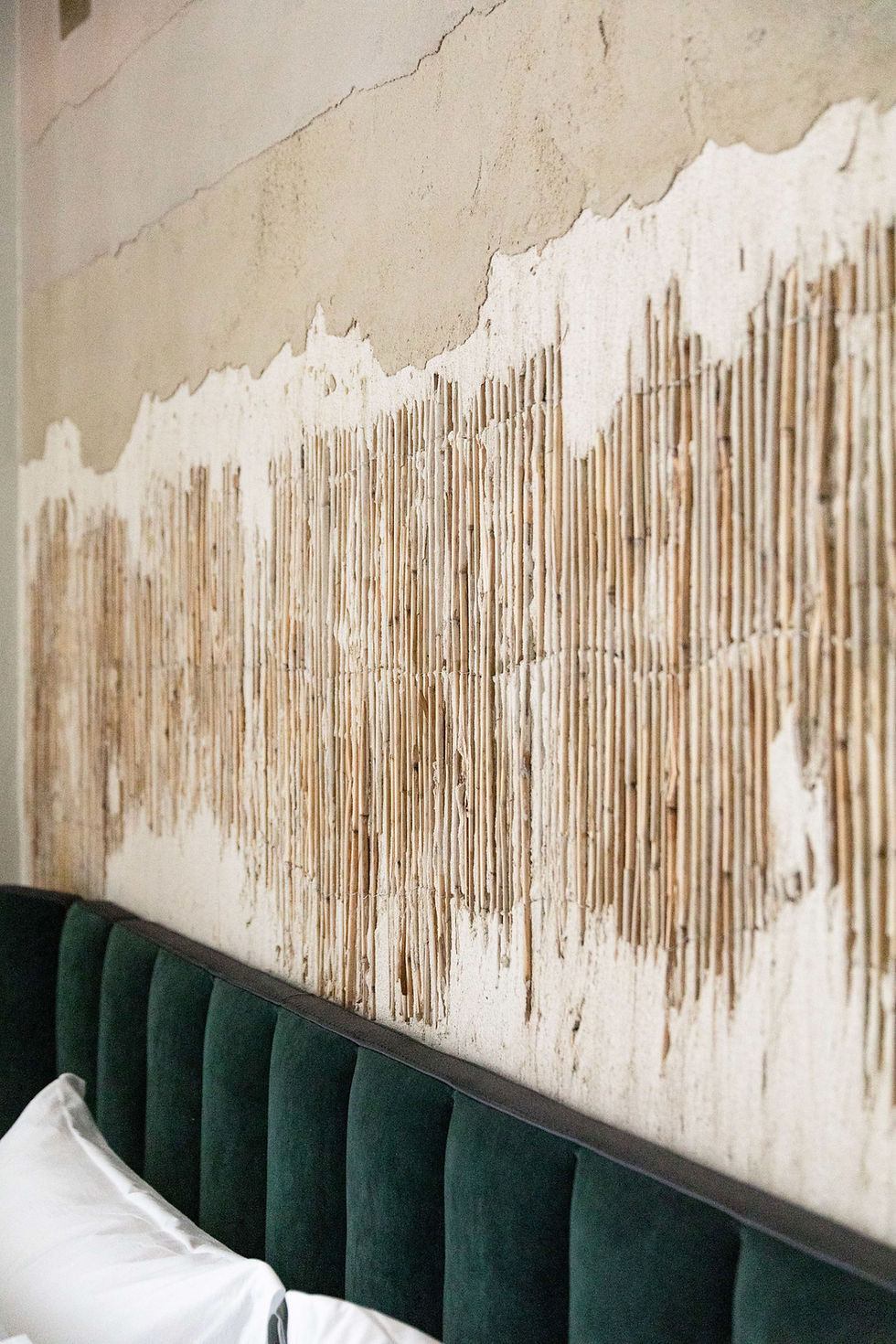
A vertical play of finely chosen clay plaster tones is layered like strata. More than fifty clay samples were produced to find the exact depth and atmosphere the room required. End grain timbers interrupt these layers, adding a material composition and breaking the flow with a quiet material rhythm, while reed mats, used for centuries as historic plaster carriers, introduce a subtle horizontal counterline. Together these elements root the wall in material history and a contemporary calm.


ROOM 104 — THE DREAM
"LE RÈVE"
A selection of linen fabrics was dyed and layered to create a play of colour and structure that evokes the quiet softness of a dream. In collaboration with artist Anna Menecia Antenete Hambira, the textiles were stitched in three layers using different sewing techniques, then mounted on a supporting framework to form a depth that draws the viewer gently inward. The result is a cloudlike composition that carries the spirit of Emile Zola’s title and turns the wall into a space of stillness and reverie.


ROOM 104 — THE PREY
"LA CURÈE"
Brass plates and hand picked wooden logs from an old sawmill near Vienna form the core of this composition. The logs were cut, shaped and dry laid first, allowing every gap to be defined so the brass could appear between the timbers with intention. Fire blackened the wood, turning destruction into design and creating a dialogue between matte surface and warm metal sheen. As the elements were applied on a larger scale, their forms were adjusted to the architecture, letting metal and timber move from raw tension into a harmonious play of contrasts that anchors the room in depth and presence.


ROOM 209 — THE SIN
"LA FAUTE"
A dark composition of jute, hemp and cotton dyed with natural pigments was applied onto layered plaster which was partially scraped back to reveal a play between concealment and exposure. The form of the wall was guided by the curved silhouette of the Hughes sofa by Munna, whose sweeping lines were translated into the surface and extended into subtle vertical steles. These gestures allow wall, room and object to flow into one another, creating a quiet harmony where material, form and contour share the same language.


DECAY
Each suite carries a sense of erosion, layering, and transformation. Colors fade into one another, fabrics fuse with plaster, wood yields to fire, and surfaces carry scars like memories. Together, the suites do not simply host guests — they immerse them in narratives of nature, desire, and time.
"These suites do not just host — they immerse guests in narratives of nature, desire, and time."